


Of all the things I hate with a passion that have arisen from our internet subculture over the past few decades, “life hacks” are very close to the top of that list.
They’re stupidly overrated. They are usually not much of a “hack” at all; they’re just tiny modifications of things you do already that are sometimes sort of clever. In my entire life, never have I ever said, “Wow, thank you for that life hack—it has changed my life!”
In every single case I can think of, when I have tried a life hack, I think “Hey, this is pretty cool!” at first. Then, a few hours or a few days later, I realize “Ugh. This seemed like a good idea, but it’s too much work, and it doesn’t really save me any time,” so I abandon it.
I mean, putting pancake mix in a squeeze bottle? Looks cool on a YouTube short; it’s actually kind of dumb in practice, and it is never as simple as it looks. Plus, now you have an additional dish to wash.
Human nature is really confusing that way: we are addicted to things like life hacks because the “curiosity gap” gets the best of us, and humans LOVE to feel like they’ve discovered a “cheat code.” (“I know something you don’t!” gives some people’s brains insane amounts of dopamine).
This isn’t just annoying—it’s actively harmful. Here’s why.
The biggest problem is not that they’re so bad in themselves; it’s that they can increase our anxiety and reduce our contentment by making us feel like we’re constantly missing out. Our inner voice gnaws away at us:
“Do I have the optimal set of life hacks?”
“Is there a way to life hack this hard thing I’m doing right now?”
“Are there any new life hacks I don’t know about yet?”
The end result is that we can end up worse off than we were before. We can’t even do normal things, like loading the dishwasher, anymore. Instead, we wonder:
“Is there a smarter way to load the dishwasher? Didn’t I scroll past a YouTube thumbnail that said ‘Are You Loading Your Dishwasher the Wrong Way?’ I’m pretty sure I did, but now I can’t remember if I watched it or not, and now I’m wondering what I’m doing wrong, and I’m getting nervous and hyperventilating, and ahhhhhh what’s wrong with me?!!”
This is a symptom of the sickness of our attention-seeking and clout-chasing digital economy.
My advice: JUST LOAD THE DISHWASHER AND MOVE ON!
Stop trying to over-optimize your life.
Good enough is good enough.
Okay, I’m just shouting to try to allay your fears in a friendly way.
So, having said all that… There are four things I learned in 2025 that are kinda, sorta like life hacks, but I would never really call them that myself. I’m just saying it here in hopes that this goes viral so I can get attention and clout. (Just kidding… mostly).
There are not a lot of changes I’ve made in my life where I can say, “I started doing this one very specific thing habitually, and I have noticed a very clear outcome from doing that.” But these ones are just like that.
For whatever reason, 2025 was the year of discovering (or at least noticing) all of them. Not sure why: maybe I just spent the whole year trying mindfulness more than usual?
Either way, here I present to you a list of things that I started doing at some point this year that actually stuck, and I have seen a demonstrable difference.
All of these together will help you decrease stress, reduce wasted time, and even help you lose weight (no joke).
If you find any of them helpful, great! If you don’t, that’s okay too—let me know what you have tried in 2025 that works for you, and that you’ll keep doing in 2026.
Drum roll, please…
Four Life Habits That Changed My Life in 2025
(And what you should do if you want to see a difference as well)
#1: Delete all “scrolling apps” on your phone
Don’t just log out of them.
Delete them.
They’ve all got to go.
Now.
You know that thing we do, where we’re all standing around looking at our phone screens, and we know it looks terrible, but we all do it anyway? We’re embarrassed by it, but we can’t stop.
I discovered what’s so addictive about my phone in 2025, and it’s not the phone itself.
Smartphones are a remarkable productivity tool.
But they are also a remarkable productivity killer.
For whatever reason, it took me until I turned 40 to realize what the difference is: mindless scrolling.
Call it whatever you want: endlessly scrolling, doomscrolling—whatever.
Whenever you catch yourself flicking your thumb up on your phone screen, you’re doing it. That’s the thing I’m talking about.
Stop it.
Stop doing that now.
Learn to recognize that gesture that has become a passive, involuntary response by now. Whenever you do it, ask yourself, “Am I scrolling?” If so, look at the app you have open and delete it.
Right now.
This works in two amazing ways:
First, the simple act of scrolling is mesmerizing and hypnotic. We fall into a trance state, and our brains turn off. We become passive consumers. That’s how people get hit by cars sometimes while crossing the street: they’re so engrossed in seeing what’s on their screen that they tune out what’s going on around them. This is literally dangerous and even life-threatening.
A rubric for deciding which phone apps to delete
Here’s a helpful rubric to know when you should delete an app from your phone.
If you’re using an app that “refreshes” the content or “feeds” you algorithmic content you didn’t specifically ask for or click on, delete it.
There you go: your decision framework is literally that simple.
If you’re looking at a feed of news, posts, articles, or videos that your phone or the app THINKS you want, but you didn’t ASK for, get rid of it.
You don’t need it.
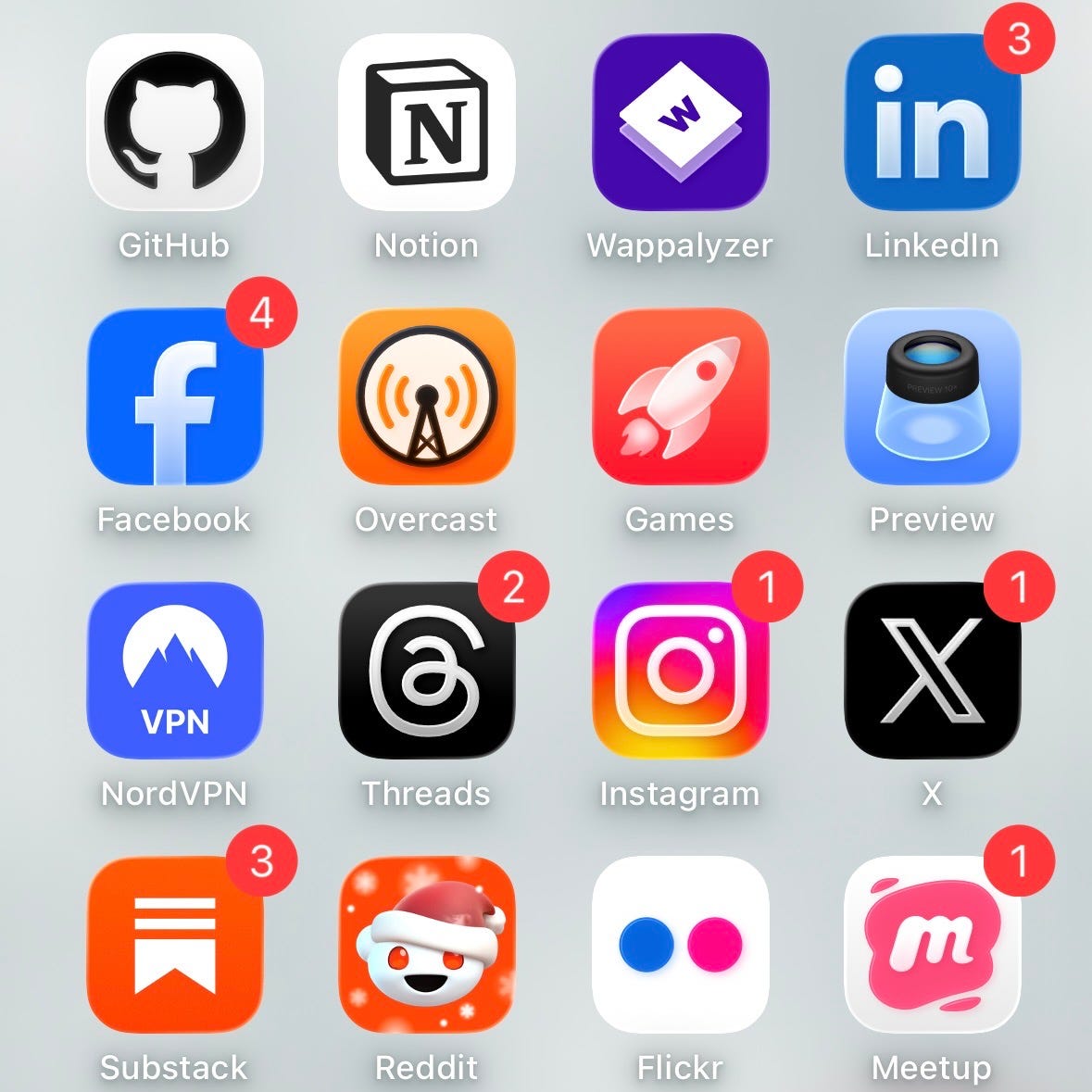
Second, most of the apps that have this kind of content also rely on giving you pop-up notifications on your phone and the little red bubble that makes you so insane you will literally do anything to make it go away.
Why? The makers of these apps know something you don’t: that all they have to do to get you to go back into their app is tell you you missed out on something. That’s the curiosity gap again—we can’t stand not knowing what we missed out on, so we open it up again to find out.
Five minutes, 10 minutes, 30 minutes later, we’re standing there dumbly looking at our screen, wondering, “Why am I looking at this?”
Social media apps are obviously the worst.
Here’s a destructive cycle I found myself trapped in multiple times earlier this year.
The 2FA Interruption Trap
Step 1: Visit Gmail, Amazon, or another website I intended to visit for the express purpose of taking a specific action, like checking my email or ordering something.
Step 2: Try to log in.
Step 3: Get a “two-factor authentication” notice that says “We just sent a six-digit code to your phone to verify your login.”
Step 4: Pick up my phone to get the code and then…
Step 5: Get distracted by all the little red bubbles, and open Facebook (or Instagram, or YouTube, or whatever)…
Step 6: Look back up at my computer, and wonder, “How on Earth am I halfway through a 17-minute video called ‘The Dark Secret Behind the Royal Family’s Wealth?’ Why am I even on my phone? What was I doing? Where am I?”
This kind of nonsensical interruption will eat into your productivity in a destructive and expensive way.
But fear not! There is a solution: delete all “scrolling apps” on your phone!
Don’t just sign out of them. Make them all go away.
Facebook, Instagram, LinkedIn (yes, even business apps), Threads, Bluesky (Uhh, why do you even have this?), Medium, Twitter/X, Substack (yes, even though this is a Substack email), and more.
If there’s some sort of life-threatening emergency where you will literally die without one of these apps, you can always download it again later.
And here’s the dirty secret that the companies that make these apps want you to forget: with every one of them, you can simply log into the service from your computer.
Every… single… one of them.
So you don’t even have to say “I’m canceling my Instagram account,” or “I’m deleting my LinkedIn profile.” You’re just saying: “I’m removing these services from my phone so that they no longer have the power to interrupt my life without my awareness or permission.”
Congrats: you are now back in control again. You can visit those websites on your computer anytime you want, at YOUR convenience.
Also, if you’re like me, after only an hour or two, you will notice something very strange: you’ll be standing in line at a coffee shop, or sitting on a bus, or eating lunch, and you’ll instinctively pick up your phone, hold it up to your face, and look at it, then be confused.
“Why did I do that?” you’ll wonder because there’s nothing for you to see there.
You are now realizing just how addicted you were to scrolling content. That muscle memory is so familiar that it’s almost involuntary to pick up the phone and place it in front of your face, expecting to see something. Except now, you’re staring at a screen with a bunch of boring apps that don’t feed you content to give you a dopamine rush.
You’ll stare at your phone like it’s a weird object you’ve never seen before.
Almost like a smoker who quits smoking cold turkey—he may start to awkwardly paw at his shirt’s breast pocket, and only after a couple of attempts to grab the cigarette box that is no longer there, does he realize, “Oh, wait, I don’t have cigarettes anymore.”
All that to say, remove the temptation—and the ability!—to have your day interrupted (hijacked, actually) by tech companies that are constantly injecting content and advertisements into your veins, 24 hours a day, everywhere you go, including your time spent on the toilet(!).
After a few weeks, you will start to not miss it anymore, and you wonder why you ever allowed yourself to fall into that trap in the first place.
Try it. It will literally change your life. At least it did for me.
#2: Read the ingredients on everything you eat or drink
No, that doesn’t mean read every single ingredient, making sure you can properly pronounce them all, and that you actually know what they all are.
(Although it would be good for you to know what butylated hydroxytoluene or carboxymethyl cellulose are, as long as you’re putting them in your body.)
It does mean doing a quick visual scan of all the ingredients and looking for the things you’re trying to avoid. This is harder than you think, for (at least) two reasons.
First, did you know that beer, wine, and many other alcoholic drinks don’t have to have nutrition facts on them? That means you literally cannot discern how many calories are in what you’re drinking just by checking the label. There is no label!
Once I got in the habit of checking the ingredients of everything I eat and drink, I noticed something shocking (for the first time) when I was drinking a beer one day:
“Wait a second, this doesn’t have any nutrition info on it. This is outrageous! How do I know what’s in it?”
So I took a picture of the bottle in my hand and used an AI chatbot (Grok) to ask what kind of nutrition facts I could get for it.
You know what I learned when I started doing this? There are a LOT of calories in alcoholic drinks! (It’s no wonder they try to hide it!) The beer I was drinking was estimated to have 250 calories in it.
WHAT?!
That means if I drank two of those beers in one evening, I’ve just added 500 calories to my body in one day! Do that a few times a week, and if you’re trying to stay slim, you’re absolutely cooked!
If you’re counting calories (though I’m not saying you should), it’s really easy to focus only on your food, and you could forget that by having two or three beers at a social event for business (for example), you may have added 500-800 extra calories to your intake that day. Do that a few times a month, and thousands of calories add up.
And you wouldn’t even know it!
On that note… even if you don’t drink alcohol, here’s the other reason you should read all the ingredient labels on what you eat and drink.
Second, it is shocking to discover that most American food is filled with
Sugar
Salt
Dairy
Soy
I’ve started referring to these as “the Four Horsemen of American food”—they’re all bad for you (well, mostly), and they’re all incredibly sneaky in the way they show up in your food without your even noticing.
For example, I used to eat cans of split pea soup or chili almost every day for lunch. For years. They’re cheap, they’re tasty, and they’re full of beans, which are good for you, right?
Well, sort of. Yes, meat and beans are good for you. But you know what is not? Sugar and sodium. And maybe I’m just naïve or stupid, but I was astonished to find out just how much sugar and sodium are added to both of these.
Sugar in chili? Yes, lots. I did not expect that at all.
Salt in chili? Well, duh. I expected that, of course. But just ONE can of chili has 71% of my daily value of sodium. YOWZA—that is a lot of sodium!
Dairy is also a sneaky bugger because it shows up in a lot of things that you don’t expect. Cheese crackers, for example, of course, you would expect there to be dairy in those. But there’s actually dairy in all kinds of crackers that don’t have even cheese in them at all. And chips are filled with dairy, too. Why? I don’t know: something about the way they’re flavored.
Soy is one of the most disappointing additives in food because there are entire categories of food where it seems impossible to get away from it.
There are lots of problems with soy that I don’t need to get into right now, but suffice it to say, for me: soy plays with my emotions in a weird way. Sometimes it literally makes me feel really sad, like I want to cry for no reason.
Why?
Because soy beans are filled with estrogen.
Did anyone ever tell you that? Probably not—certainly, nobody ever told me that.
But one day, I started wondering why I always felt like crying in the middle of the morning after I ate my daily granola bar at my computer at the office.
I looked at the ingredients list, and: BOOM—SOY! Tons of it.
I started rifling through all my boxes of granola bars from different brands, all with different flavors… Every single one of them was filled with soy.
I threw them all in the garbage can in a total and utter rage.
I had been sabotaging my own mental health every morning just by doing something I thought was good: eating a quick breakfast on the go that had lots of protein in it.
Your mileage may vary, but soy, at least in its processed form, is a terrible additive, and it is all… over… the… place… These days, I avoid soy like a toxin.
You may love soy, and that’s fine. But you should at least KNOW that soy is in your food. And, as I’ve said, there are a LOT of food items out there that have soy in them that you’d never guess. (I never did, anyway.)
Try it. It will literally change your life. At least it did for me.
#3: Make one day per week your “admin day”
When I used to work for an employer (many years ago), the company I worked for was sold, and the new company owner made a lot of changes as soon as he took over.
Most of the changes he made were very unpopular. People started quitting in droves. I knew I wasn’t long for the company either, but one of the changes he made at the beginning was so simple it was absolutely brilliant. He told me:
Ron, from now on, you are not allowed to meet with clients on Fridays. I forbid you to have client meetings on Fridays, no matter what. Use Fridays for administrative tasks so that you can close out the week in a strong way and be prepared to come back to the office on Monday and hit the ground running.
I asked him, “What if a client asks me to meet with her on a Friday and it’s the only day she can meet, or if she says it’s urgent?”
He said:
Nope. No deal. Make me the bad guy if you need to. Throw me under the bus. Tell them ‘I’m sorry, but it’s a company rule; I’m not allowed to meet on Fridays.’
This was a genius stroke. And it’s something I took with me from that job. A few years ago, though, I sort of forgot about it and stopped doing it habitually. But in 2025, I implemented it again. Instead of Fridays, I made it Mondays.
I do not meet with clients on Mondays. Those are my admin days.
Although I don’t have a boss to throw under the bus, and sometimes I do compromise if somebody says it’s the only time they can meet, I do religiously block off time in my calendar on Mondays.
This does not mean I block off an hour or a few hours for admin tasks.
It means I block off the entire day.
No meetings.
No Zooms.
No extended phone calls.
I am in the office, but I am unavailable. I can respond to emails, no problem. But actually having a meeting? It’s against the rules.
If you can, whether you’re employed or work for yourself, take at least one business day every week, and allow yourself to catch up on busy work, scheduling, research, continuing education, bookkeeping, invoicing, or any other administrative tasks you have, and do not allow this to get derailed by meetings.
Meetings are absolute productivity killers, and the more meetings you have, the more productivity you kill… even if they’re good meetings! This doesn’t mean you don’t ever meet with people. It just means you don’t meet with people on your “admin day.”
Here’s a trick I’ve implemented to make explaining this a bit easier for clients. I’ve started vocalizing my rule, politely, but rigidly.
When we talk about having a meeting, I’ll say: “Let me see what’s on my calendar for next week… Monday is out, because that’s my admin day and I don’t schedule meetings then.”
With perhaps one or two exceptions, nobody has given me pushback. Nobody has ever said, “I refuse to meet with you on any day except Monday. It MUST be Monday.”
For some weird reason, I’m always afraid they might, but they never do. In fact, sometimes people say, “Wow, that’s a good idea. I should do that myself.”
Yes. You should.
Block off one day per week—the same day every week—for admin day. If you can’t do a full day, do a half day. Whatever you choose, keep your promise to yourself that you will respect your own time and boundaries.
Try it. It will literally change your life. At least it did for me.
#4: Take a walk
That’s it.
Take a walk.
It’s literally that simple.
Take a walk every single day.
I actually recorded a video about this topic years ago for an educational course I made for freelancers and solopreneurs (you can watch it here, if you’d like).
I take two kinds of walks every day (or at least I try to):
Type 1: The “Problem Solving Walk”
When I get stuck on a complicated problem, and I’m sitting in front of my computer, I can either click around in frustration or stare at the screen, waiting for inspiration to arrive, or I can just take a walk.
In a problem-solving walk, the point isn’t the walk per se—it’s to try to solve the problem in a different context.
With a change of scenery, many times I found that I can simply stand up, step out of my office with my phone in hand, or sometimes a tiny notepad and a pen, and walk for a mile or two, with the goal of solving my problem by the time I get back to the office.
With this walk, you take your problems with you.
It is amazing how well this works. By removing myself from my office environment, this somehow allows me to think in a way that is more stimulating and unrestricted. So I will set a goal for myself: “I’m going to go for a walk and not come back until I have an answer to this problem.”
Sometimes, that means I walk around the block. Sometimes that means I walk 10 or 20 blocks. It just depends on the severity of the challenge and how many ideas come to me in that span of time.
Try it sometime: it really works. Plus, it’s good for you! It is good for your health to exercise your legs, get your blood pumping, elevate your heart rate, and breathe fresh air every day.
Type 2: The “Freeing Walk”
I try to take one of these walks each day, too, and it’s the literal opposite of the problem-solving walk. With this one, I walk out the door with only my keys.
That’s it: no phone, no earbuds, no notepad, not even my wallet—nothing that can distract me from freeing and clearing my mind, and no tasks or agenda.
I can’t answer the phone, respond to text messages, scroll on apps (Ha, fooled you! I already deleted all my scrolling apps!)
With this walk, you leave your problems behind.
Here, I just walk around and observe things. I look at the trees, listen to the birds, smell the flowers, or the scent of dirt in the air—whatever that day brings to me.
There’s no agenda here, and I’m not allowed to think about business.
I just walk and observe.
I see what happens. Explore a new territory, try a new route, pass by a new business, or whatever else catches my fancy that day.
(Seriously: I found my new barber this way. I just walked a few blocks, discovered a barber shop I’d never seen before, and thought, “I should go in and say hi.” I’m glad I did! He’s been cutting my hair ever since!)
Sometimes, if I’m really stressed out, I’ll take more than one walk. If I have a stressful meeting or a complicated phone call, I’ll take a walk before I go back into another meeting or take another call.
If I have meetings or calls stacked together, I’ll take a walk between each one. Simple.
Try it. It will literally change your life. At least it did for me.
I hope you found these helpful. After 40 years on this earth, whether it’s at work or at home, I’ve found that the secret to these kinds of things is not simply doing them.
It’s in making them a habit.
It doesn’t help if you just try them once or twice or 13 times. They only work if you do them every day or every week. And the good news is, once you get into a good routine, all you have to do is keep it up. And it is way easier to keep doing something that has become a habit than to start a new habit.
So if you try them long enough to ingrain them in your mind and muscle memory so they feel like part of your daily or weekly agenda, you’ve already done the hardest part.
Let me know if any of these sound particularly helpful to you, or if you have other “life habits” that you recommend that I try. What are your secrets?
I had delated the scrolling apps on my phone before, but over the last few months had reloaded them. I had been debating deleting them again. Reading your article when it says, "Stop it. Stop doing that... Right Now." I went and deleted them all again. 😆
I love your list! I agree with all of these. And yes, soy can give men "man boobs" too! My life is so much better and more productive after getting rid of lots of things on my phone, especially facebook. I just login occasionally on my laptop to check it. I find myself getting more infuriated recently at how distracting my phone can be, when I go to check one thing and find myself wondering 5 minutes later what I was going to do! I have actually considered getting a "dumb" phone. Another thing I implemented years ago is having unknown calls go to voicemail and I never have my peace stolen by someone I never wanted to talk to in the first place! Haha. I intend to implement the daily walk in 2026, I have always been so bad about that but I know it would be great for me.