


Today, like many (or perhaps most) American families, my wife, children, and I will be watching Super Bowl LX.
We will relax on this fine Sunday afternoon, sit on the couch, eat snacks, and shout at the TV as we participate in a great American tradition that, for sixty years, has become so embedded in our culture that we can’t even imagine life without it.
Some of my fondest childhood memories include rooting for my team on Super Bowl Sunday, with my family members (and especially my dad) watching with me. Even when my team lost—which was almost always the case—it was still a worthy event and a cause worth celebrating.
I shed angry tears and bit my tongue sometimes when the outcome wasn’t what I wanted, then spitefully promised myself “next year,” then was disappointed again and again, with an occasional win thrown in that made it all worth it.
To this day, even when teams I have no interest in make it through the playoffs, I’m always intrigued enough to wonder, “Who is going to the Super Bowl this year?”
As an American, I’m used to the fact that it seems one of the favorite pastimes of Americans is criticizing America. There is seemingly endless demand for outrage, anger, and infighting over everything that’s wrong with America.
In my lifetime at least, there have always been one or two occasions where we could put aside our differences and cheer on the sidelines, if not for the same team, then for the same cause.
The Super Bowl is one of those occasions.
Or rather, it used to be.
Sadly, though, like almost all aging institutions that have made our country, cultural tradition, and heritage something good and worth celebrating, the Super Bowl has lost its shine, and it is starting to show signs of age, corrosion, and rot.
The Super Bowl was, of course, designed to be a spectacle, but not the kind of spectacle it has become.
Of all events in American sports, it was the one designed to bring people together, but it has become increasingly more divisive over the years.
I’ve watched as the people who hold the purse strings have moved from being a small annoyance that produces eyerolls, to a minor interference that creates division and defensiveness, to what it is today, where they now seem intent on making it openly provocative, even using it as a platform to drive a wedge between Americans to create division in one of the last great arenas where there is (and should be) very little.
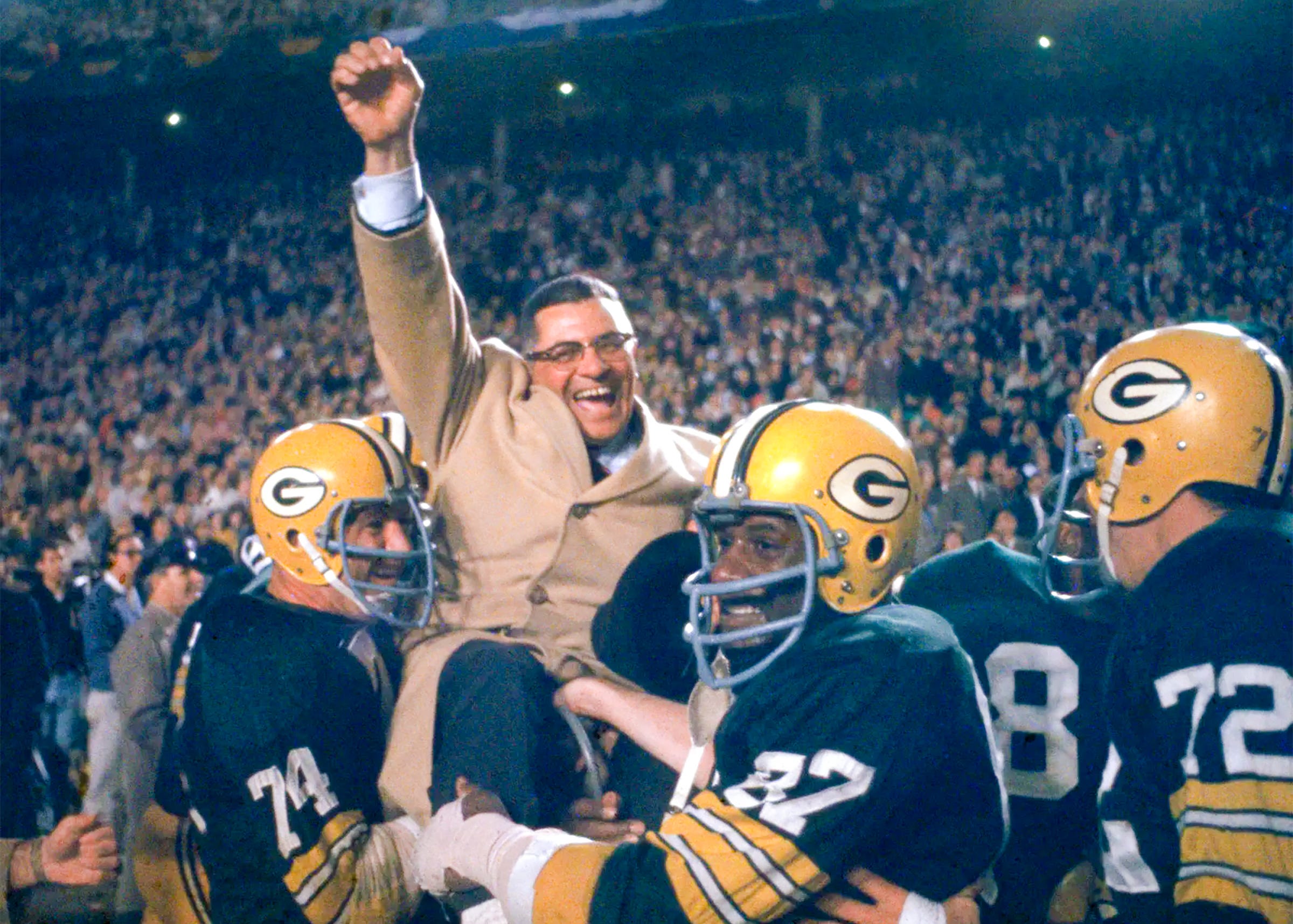
I shudder to think what Vince Lombardi would think about what it has become today. The legendary coach of the Green Bay Packers (the winner of the first two games) and the man for whom the Lombardi Trophy, which is awarded to the Super Bowl’s winning team, is named.
Coach Lombardi believed that football is:
“A game in which hundreds of thousands of Americans take part that is completely uninhibited by either racial or social barriers.”
“A great symbol of what this great country’s attributes are: courage and stamina and a coordinated efficiency or teamwork.”
Something that “teaches that work, and sacrifice, and perseverance, and competitive drive, and that selflessness, a respect for authority, is the price that each and every one of us must pay to achieve any goal that’s worthwhile.”
I agree with him.
Coach is right that “‘Love’ is not necessarily ‘liking.’ You do not need to like someone in order to love them. Love is loyalty. Love is teamwork.”
Coach was also apt in his overall assessment of love and unity across divides:
“I’m not advocating that love is the answer to everything… when I speak about the love which forces everyone to love everyone else—for example [that] you’ve got to love the white man because he is white or the black man because he is black or the poor man because he is poor or your enemy because he is your enemy—but rather a love of one human for another human who just happens to be white or black, rich or poor, enemy or friend, because heart power is the strength of America, and hate power is the weakness of the world.”
Today, this is the Super Bowl I choose to watch. Not the divisive, painful ordeal it seems destined to become, but the unifying tradition Lombardi envisioned.
Today, I reject the efforts of revolutionaries to make me hate myself or my fellow Americans, and to choose division and distrust over peace and friendship.
Today, I ponder the efforts and seriousness that the Patron Saint of Green Bay (a highly devout Christian who went to daily mass, prayed often, and made his faith central to his life) gave to American professional football and the power it had to bring people together.
As he famously said, “There are three things that are important to every man in this locker room. His God, his family, and the Green Bay Packers—in that order.”
Today, I celebrate sixty years of Super Bowl Sunday, a day of worship and rest where we observe the importance of God, family, and sports—in that order.
Today, no matter what happens, on or off the field, before or during the game, I refuse to let partisan actors use sports and music as a weapon to anger me over social politics that don’t affect us nearly as much as we’re told they do.
Finally, I am thankful for sports events like this, and I celebrate that no matter what agitators say, Americans are one people, united under one national anthem, flying one flag, in one country, under God.