


I keep noticing something on Substack, and it’s both fascinating and horrifying.
It’s not a negative critique of the platform itself, and, if anything, I’m actually saying it’s a strength. Free speech platforms like Substack are giving us something we’ve almost never had before: the ability to watch very bad ideas being developed, refined, and legitimized in real time: it’s all out in the open, with names and faces attached.
While it seems counterintuitive, this is precisely why free speech is worth defending.
When publishers like “The Bulwark” and writers like Robert Reich and Heather Cox Richardson plot their plans out in the open, for everyone to see, it’s extremely valuable even as it is incredibly unsettling.
For most of history, we could only discover dangerous ideologies after the damage was done.
Investigators would comb through private journals, manifestos, and notes found in bedrooms and basements, piecing together what someone believed, dreamed about, and planned, once it was already too late to matter.
Those documents might satisfy some level of curiosity, but they’re entirely useless for prevention. What’s different now is that we don’t have to reconstruct hidden manifestos after the fact.
Substack allows us to see, with clarity, how these ideas form, harden, radicalize followers, and gain confidence before they metastasize into policy or action.
This visibility matters: when bad ideas are built in public, they aren’t hiding. But that is also a double-edged sword, because those of us who object to burning America to the ground can’t say these movements came from nowhere.
I’ve said this many times: if you want to see a “who’s who” of the most destructive ideologues in America right now, they’re all on Substack— many of them on the “Substack Bestsellers” lists with orange and purple checkmarks next to their names.
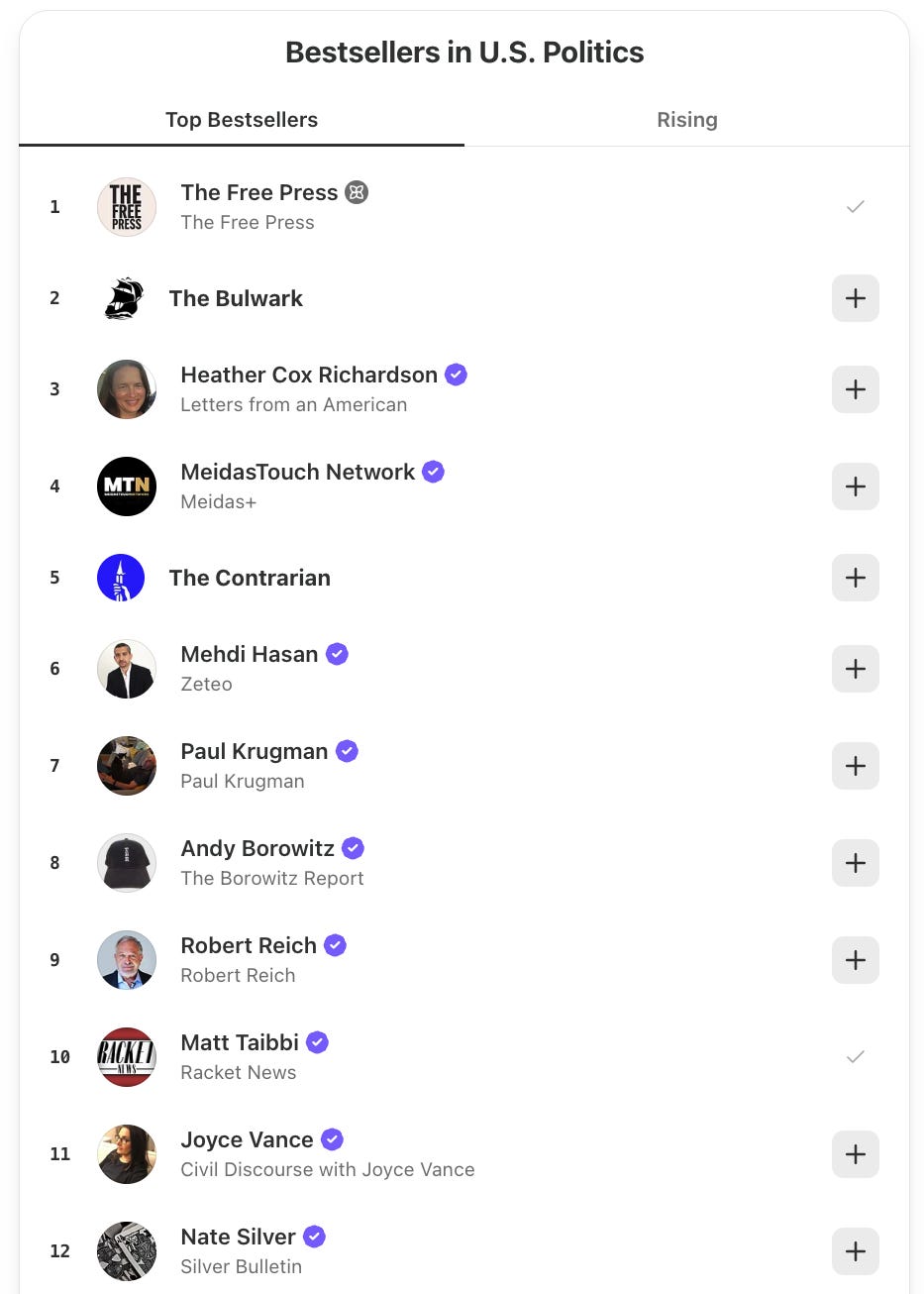
That is not what’s most alarming, though. It’s already breathtaking that these ideas exist and that they’re being articulated publicly. But what’s worse is that hordes of people are paying for them. These destructive voices are being amplified, celebrated, and endorsed, and every $9/month subscription is a literal investment in their ideologies.
America is very sick right now: the market signal is telling us, “Give us more of this.”
For years, I have watched my home state of California systematically kill the golden geese that made it great by going after founders, business owners, entrepreneurs, risk-takers, etc.
The convoy out of the state has grown so large that even the patently nonpartisan U-Haul has provided hard data that shows what many have long-suspected to be true: namely, a LOT of people are moving away from California.
Just look at this incredible nugget right at the top of the U-Haul® Growth Index released last week: “California ranks last with the greatest out-migration number for the sixth consecutive year.”
But they’re not done yet: Sacramento is not content to simply run the rank-and-file out of the state—they’ve now proposed a “Billionaire Tax” (which is literally just a first-in-the-nation state-enforced wealth confiscation scheme).
And for weeks, I have been pondering: who could possibly have dreamt up something so profoundly stupid and destructive? Well, today, I got my answer.
“Currently, the policy is on course to work as its architect, the malevolent dark elf Robert Reich, apparently intended — unless, and I genuinely don’t know how this is possible, he really is too stupid to understand what he just did.”
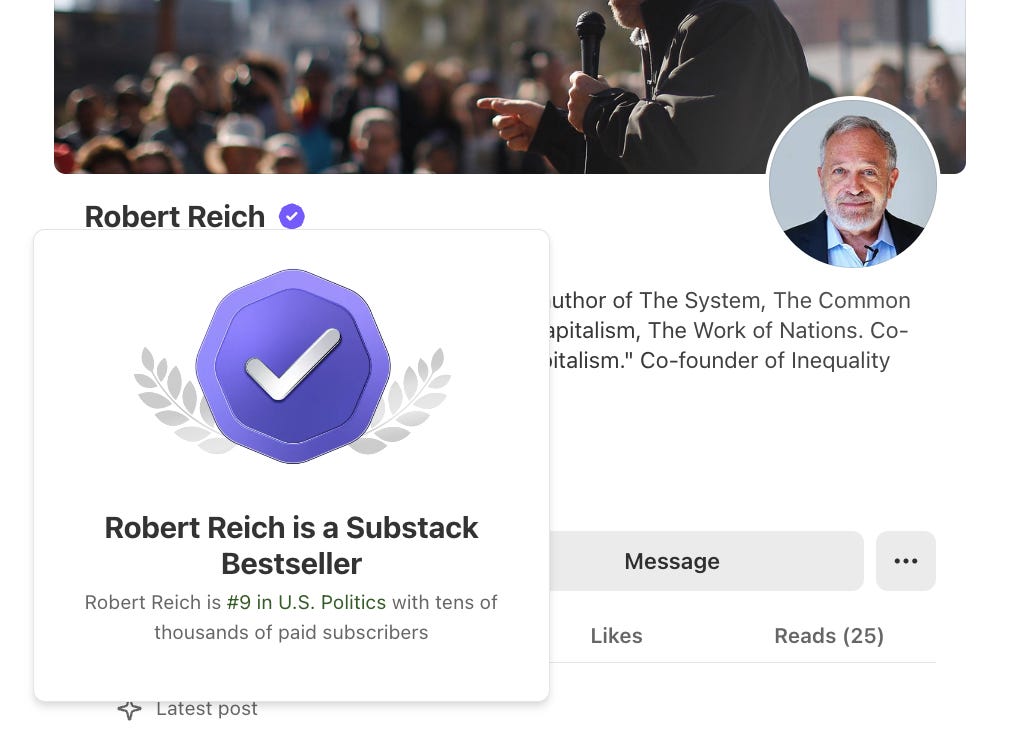
The “malevolent dark elf” referred to here is the #9 bestseller in “U.S. Politics.”
This man, intent on monkeywrenching America’s economic and political stability, has (somehow) found a way to make his horrible ideas jump off the page and into real legislation being formed right now in America’s most populous state.
And remarkably, tens of thousands of subscribers pay for a steady stream of caustic ooze flowing from the jealous keyboards of “disarchitects” just like him, who are inventing “billionaire taxes” out of thin air.
Again, there’s nothing wrong with the platform itself—Substack is doing its job, which is giving the people what they want. It’s just a mirror in that sense, or, perhaps a better metaphor: an X-Ray, showing us what’s just beneath the surface if only you care to look.
But it is a profound indictment of our not taking the paradox of free speech and the marketplace of ideas seriously. With total freedom of expression comes responsibility, yet American society is derelict in its duty to counter awful arguments with better ones.
To put it plainly: in 2026, ideas don’t have to be good to spread.
They don’t even have to be logical or coherent. They just have to be emotionally intoxicating (e.g., “Tax the billionaires! I’m not a billionaire; this won’t affect me!”)
This is how it works now, and I don’t think people are paying attention: to be clear, no one is being silenced. No one is being heckled or shouted down. This isn’t like watching calm speakers drowned out by protesters with bullhorns (as is often the case in the AI hysteria and fights over building data centers).
No, it’s far worse than that.
The serious voices exist. The counterarguments exist. The planners and adults are still speaking.
They’re just losing.
They can’t even claim that they’re being deplatformed or cancelled anymore. Substack is proof enough of that. Better men and better ideas are losing not because they’re forbidden or “ghost-banned,” but because they’re boring.
Restraint doesn’t go viral. Rage converts better than responsibility.
And this is what really keeps me up at night. Not that so many bad ideas are visible, but that they’re winning. That people are smiling, clapping, and paying for them.
After Columbine, everyone said, “We didn’t see this coming.”
This time, we can’t say that.
The American electorate is addicted to resentful, moralizing, apocalyptic content, and this addiction is contagious. It’s spreading faster than anything careful, measured, or sane.
What a bizarre time to be alive.
In the future, if and when “political science” ever returns to a respectable, substantive field of study again, they will not ask “Why didn’t they see this coming?”
Because we did see it coming. We watched it happen, in public, in real time.
Instead, they’ll ask: “Why didn’t anyone stop it?”
And to that, I don’t have a good answer.
I think a lot of the big accounts are astroturfed, with fake subs - including many of the paid subs too (not all but a significant number). It’s a public payoff.
> To put it plainly: in 2026, ideas don’t have to be good to spread.
This has always been the case. If you think this is a novel situation you have just uncovered, you are too naïve and ignorant of human psychology to be taken seriously.