


Sigh… the 24/7 news cycle is an embarrassing spectacle in the 21st century. It is January 2026, and the hottest news of the hour is Greenland.
Greenland? Really?
Everybody seems to be talking about Greenland now—it’s literally the top story on the front page of CNN as I write this. Cue the onslaught: endless hours of talking heads shouting at each other about it.
It’s remarkable how something almost nobody thought about five minutes ago has suddenly become a mandatory opinion. Everyone is scrambling to catch up, strike a posture, signal outrage, and demonstrate that they, too, have a take.
I want to ask people to pause here for a moment. Not to argue for a specific policy or defend anyone in particular, but to ask a simpler question:
How did this become the drama du jour? And what does the reaction tell us about how we process information now, when something very real is hiding behind a joke?
One of the biggest problems today is that we can never speak of any idea or statement made publicly without first talking about who said it. Today, the news is all about the source first, then content.
So, let’s talk about the elephant in the room: Donald Trump, who is the king of media manipulation. I don’t know anybody else who can get reporters to dance for him on command as he does.
Even the NY Times had to admit in 2016, before the election even started in earnest, he had already procured almost $2 billion worth of free media attention. At some point, you’d think reporters would get over it, but every time he says anything outrageous, the camera shutters go wild, and the video starts rolling.
Some things he says are totally outrageous or deliberately provocative. Obviously.
But to be honest, “TRUMP SAYS SHOCKING THING” is the least shocking thing we see on a daily basis.
The biggest problem with most news stories is that it is almost impossible to separate signal from noise. We don’t have answers to the most basic questions that matter, like whether something is real, whether it really matters or not, and how we should think about it.
The Greenland story is a perfect example of systemic failure, the lack of seriousness in public discourse, and the absence of journalistic rigor. Somehow, during his first presidential term, rumors flew that Trump asked a question that sounded so preposterous it was dismissed out of hand.
“Can we buy Greenland?”
The response was predictable. Hand-wringing at the highest levels of statesmanship that produced sweaty palms of epic proportions. Pearls clutched so hard the sound rattled across the Atlantic.
Trump was now Eliza Doolittle at the Ascot Opening Race, mortifying everyone in attendance by shouting: “Come on, Dover! Come on, Dover! Move your bloomin’ arse!”
The Wall Street Journal claims that in the spring of 2018, at a business dinner, Trump mentioned that someone told him Denmark was having trouble funding Greenland. Whoever this unnamed source also suggested an unorthodox solution: “Why don’t you buy it?”
“‘What do you guys think about that?’ [Trump] asked the room,” the WSJ reports. “‘Do you think it would work?’”
It’s clear from how the story is framed that everyone thought it was a joke. Not as in “just a half joke with a kernel of truth in it,” but a full-blown “Haha, OMG that’s hilarious, did you hear what he said?” kind of joke.
Before we laugh this off, though, it’s worth asking a dangerous question: has this idea ever been taken seriously before—or are we mistaking a first thought for a punchline?
I’m no expert on Trump or real estate deals, but I am a business owner myself.
Almost everything big or ambitious I’ve ever done started as a thought that sounded outrageous at first. I don’t think I’m unique that way.
It’s pretty simple.
First, a wild idea pops into your head, or you hear someone else suggest it, perhaps seriously, or perhaps humorously.
Second, you start to wonder: “Hmm… wait a minute. Is that even possible?”
Third, you start talking to people in your inner circle to see what they think. You ask things like “What do you guys think about that?” and “Do you think it would work?”
Exactly like Trump did in 2018.
From there, you do some research, weigh the pros and cons, and eventually, you make a decision and move forward.
When Trump first toyed with the idea of running, most people (myself included) thought it was all just a big, goofy publicity stunt to get us to remember who he was, or watch The Apprentice, or sell Trump Steaks, or whatever.
It was all just an act to build notoriety and sell his image as a celebrity, we thought. But then, he did two things nobody expected him to do:
He actually ran.
He actually won.
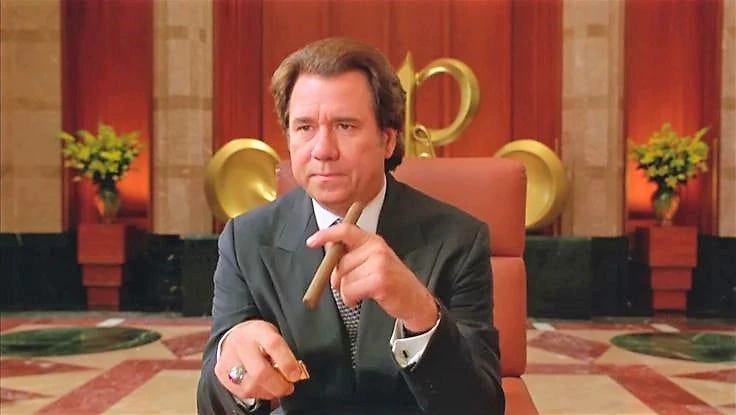
With a story like this, the media organizations cast Trump as Lawrence Van Dough in Richie Rich: a wooden, one-dimensional, comic-book villain. He bombs an airplane, gives an evil grin, laughs an evil laugh, lights a cigar, and says:
“After I plunder the Rich family vault, I think I’d like to buy a country somewhere. Something small, not too ostentatious. Luxembourg, perhaps, or maybe Ecuador?”
Only bad guys buy countries. It’s common knowledge. We all know this.
But these caricatures of real people with real power insult the intelligence of the rest of us, and they also diminish the bigger question at hand: What’s so wrong about buying countries anyway?
When I first heard about Trump wanting to buy Greenland years ago, I didn’t think it was a joke. I know he says a lot of crazy things, but this one hit different. My first reaction was, “Hold on, what’s his motivation here?” There was clearly more to this story than meets the eye.
It really sent me digging deep to learn why he would say this. It couldn’t just be that he’s an evil billionaire chomping on a stogie, wondering how he could possibly spend all his ill-gotten treasure.
But I didn’t see any news stories that took that question seriously.
All the articles I found were “Trump said this outrageous thing; world leaders reacted with scorn and embarrassment.”
In the whitespace between the lines, I could almost make out the unwritten subtitle: “Obviously, they’re all laughing at him. Because they are smart, and he is just so, so stupid.”
But really, why would an American president say something like that? I wondered.
I didn’t wave it off as lunacy. I pondered it deeply, and it seems that few others did.
Trump is especially good at voicing questions that don’t just cause outrage in and of themselves—people are also outraged at the audacity that such a question could even be asked.
But hear me out: let’s go down this rabbit hole for a moment. Let’s assume, if only for the sake of argument, that America’s 45th and 47th president is asking some questions that may be wild but are also fair:
Is Greenland even for sale? Why would we buy it? What’s in it for us? What’s in it for them?
All of these questions are, actually, perfectly reasonable. And any attempts to wave them off as illegitimate are not reasonable.
“You don’t buy countries. It just isn’t done” isn’t a good answer. (It’s also not true).
“Greenland is part of Denmark. It’s always been that way” isn’t a good answer. (It’s also not true).
“Asking questions like that isn’t polite” isn’t a good answer. (It’s not even an answer, actually).
These are all deflections, not answers. And yet, almost all the responses I’ve seen so far sound just like them.
Hear me out as I ask my own outrageous question:
Why can’t we take questions seriously, even if we don’t like the person who asks, or the way they’re asked?
Something Trump does unusually well is ask questions with a childlike sense of wonder and curiosity. He’s willing to ask things that seem obvious but sound stupid, but often aren’t.
He asks questions like “Why are things the way they are?” and “Should it be that way?” When the consensus makes no sense, why not challenge the consensus? It’s the right thing to do.
It’s frustrating when I’m trying to get to the bottom of an issue and find that people don’t really want to know the answer: they’re just interested in spouting preconceived notions that can’t be questioned.
In this case, the presupposition is that: “Greenland is not for sale.”
But seriously… How do you know? When is the last time anybody asked?
I’m glad Trump asked. And because he asked, I also asked.
And guess what? Believe it or not, there’s actually an answer. In fact, there’s a long and storied history behind this exact question.
Saying “Greenland is not for sale” is easily debunked.
Time for a quick history lesson!
But first: a reminder to set the stage for how we got here…
Donald Trump says something totally bizarre and outlandish, like “We should buy Greenland.”
The world laughs.
Denmark says, “Greenland is not for sale.”
Americans scoff.
People say he’s out of touch. He’s a lunatic.
Also, that’s a stupid idea. This could never happen.
But after the initial shock of such an audacious and unexpected proposal, with only a few minutes of reflection, anyone—including you—can see this is not a stupid idea at all.
It’s not even a new idea. (Or a “Republican” one.) It was proposed by America multiple times in the past.
After Secretary of State William Seward’s successful acquisition of Alaska from Russia in 1867, President Andrew Johnson (a Democrat) seriously considered acquiring the island (though it never materialized into a formal offer).
In 1910, President William Taft made an informal proposal for a “land swap” to Denmark, whereby we would gain Greenland in exchange for parts of the Philippines. It was never solidified beyond informal exploration, though.
Later, in 1946, President Harry Truman (a Democrat) made an outright bid for Greenland with $100 million in gold to Denmark, which then rejected it.
After a decade, for strategic reasons during the Cold War, the Joint Chiefs of Staff made a recommendation to President Dwight Eisenhower in 1955 to acquire Greenland. On the advice of the State Department, he chose not to pursue it officially.
So, whether these efforts were formal or informal, and whether they led to direct negotiations or offers… why was this such a stupid idea when President Donald Trump floated the idea in 2018 and again in 2025?
Four American presidents considered or proposed to buy Greenland, whether the idea was reciprocated or solicited by Denmark or not.
So why is it only stupid when Trump says out loud what four previous presidents (including two Democratic presidents) also suggested?
That doesn’t make any sense at all.
Also, there’s an especially rich irony in any discussions of negotiating real estate deals with the Danes in particular.
Why? Fifty years after buying Alaska from Russia, America made an offer to Denmark to buy another island—a set of islands, in fact—the Danish West Indies.
And even a cursory reading of the history of that acquisition shows that what happened in the past is echoing today.
See for yourself!
In 1916, President Woodrow Wilson (now our third Democrat) and Secretary of State Robert Lansing, borrowing from James Monroe and Theodore Roosevelt, first spoke softly, then threatened with a very big stick.
Concerned about recent events and Danish recalcitrance, Lansing implied that if Denmark was unwilling to sell, the United States might occupy the islands to prevent their seizure by Germany.
Preferring peaceful transfer to occupation, the Danish government agreed to Lansing’s demands, and Brun and Lansing signed a treaty in New York on August 4, 1916.
Sound familiar?
In other words, Denmark told the Americans, “The Danish Indies are not for sale.”
It turns out they were.
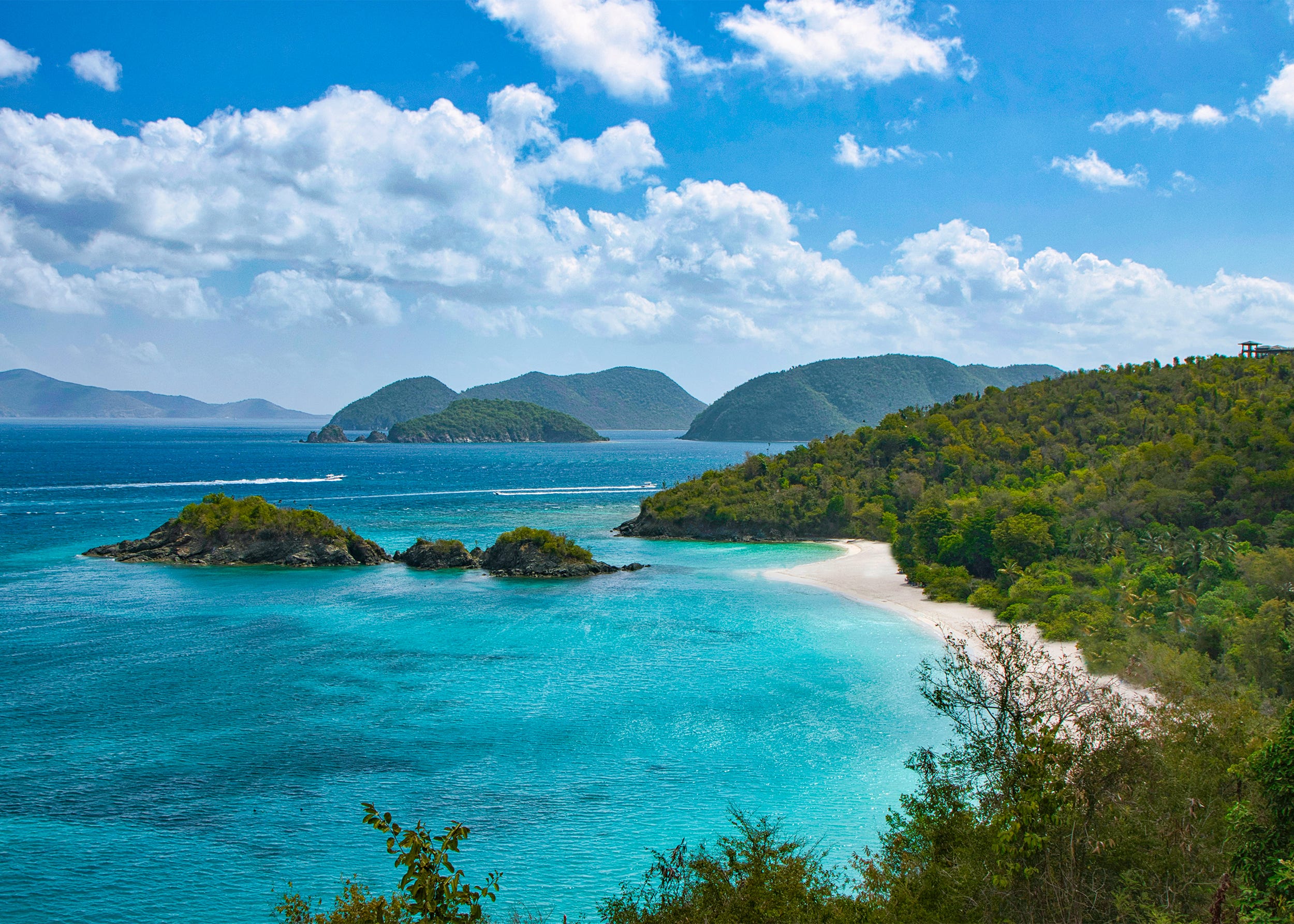
We call them the United States Virgin Islands now.
(They’re featured in the photo at the top of this post, by the way).
Who knows, we may soon pluck another island from Legoland to add to our collection, by hook or by crook?
I’ve been to both Alaska and the U.S. Virgin Islands—both questionable acquisitions at the time. I’m glad we have them today, and that Russia and Denmark don’t.
Who knows? Maybe for my next vacation, I’ll be booking a flight to Trump International Airport on U.S. Greenland Island.
Buying Greenland really is a serious proposal after all: in fact, the deeper you dig, the more you see just how valuable having control over the world’s largest island could be.
Why?
In a word: Russia.
In two: Russia and China.
When you view the world as it really is—as a globe—and not a whimsically flattened distortion like the Mercator Projection is, it immediately becomes clear.
As the USA’s Realtor in Chief, Trump knows that it’s all about location, location, location.
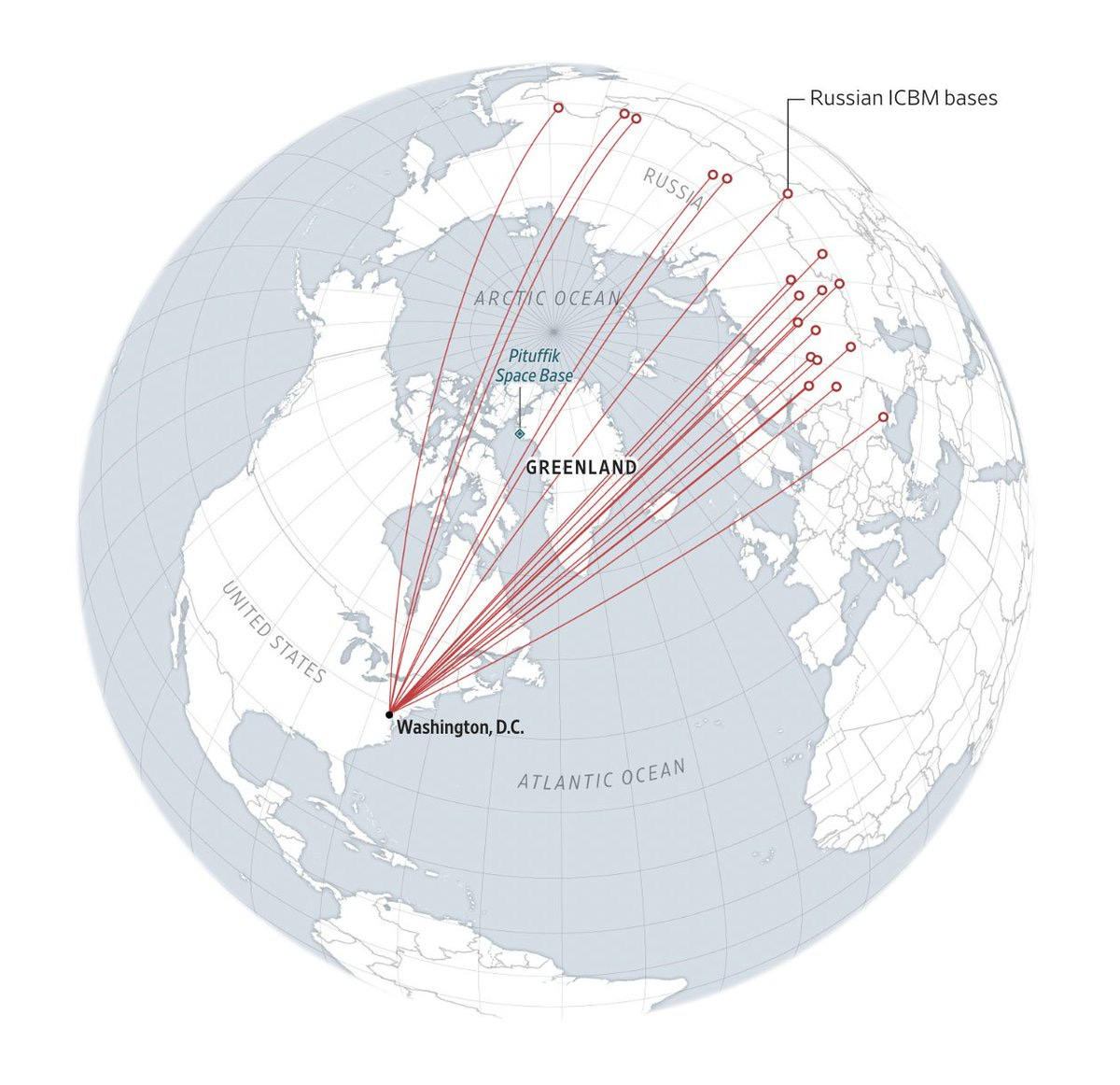
China is inserting itself in America’s backyard via its Belt and Road Initiative by attempting to build multiple airports in Greenland—the first effort of its kind this close to us—which is an astonishing intrusion into our sovereignty and a bold attempt at piercing the shield of the Monroe Doctrine.
Russia is the world’s biggest nuclear power, and—don’t forget, the country we’re funding an active war against—is somewhat unchecked in the Arctic region right now.
So, with vast navigation rights in the Arctic passage next to Russia, plus the most brazen effort yet by China to meddle in the Western Hemisphere, it’s no wonder America’s top real estate developer wants to make the greatest land deal in the history of the country.
Which raises a reasonable question: why shouldn’t the United States at least explore relieving the financial pressure on the Danes? They can stop spending $1 billion a year on a frozen island 2,300 miles away from Copenhagen with a population smaller than Kalamazoo.
Why not at least ask?
Ron,
Thanks for a very thoughtful article. Your remark that today, people are more concerned about "who said that?" than they are about what was said, is spot on! Reminds me of the man-on-the-street interviews where the interviewer says "The president said XYZ (outrageous, shocking, politically incorrect) thing. What do you think about that?" And the man on the street responds "Why, that's clearly outrageous, racist, stupid! The president should be impeached for saying that! It shows what an idiot he is!" And then the interviewer responds "Really? Hmmm. That's interesting. See, I said "The president said..." but I never said WHICH president said this "outrageously racist" thing. In fact it was not today's president, but another, recent president of the opposite party, whose Tee-Shirt you are now wearing."
Then, after a brief look of shock, and "Oh shoot, I've been trapped!" type expression, comes the man/woman on the street's response. "Um, er, well yes, I think I could see how he might have said that. Y'see that whole situation is nuanced, complicated, and if you dig deeply enough, it's actually a perfectly legitimate thing for that president to say."
Uh huh. Right...
Anyway, back to Greenland. Turns out, Greenland has never been a "country." Greenland has always been a possession of another country. Yes, it has always been a place where some hearty souls have lived; scattered tiny clans of Paleo Inuits, Norsemen, and "Thules." And there were times of rough climate change when absolutely nobody lived there.
Greenland has never had her own King, her own Armies, borders, her own sovereignty. She's the largest island in the world. She is about 850,000 square miles, 80% covered by a sheet of ice, only 20% habitable, but the total land area of all developed towns combined is less than 13 square miles. She has no trees, except in a tiny valley of about 10 square miles. In a sense, Greenland is a rock, covered with ice, and few people, and has never been a country, ever. She still isn't.
I have some friends who bought an entire island in the Caribbean Sea. Did they purchase a "country?" Nope. They bought a rock, which has sometimes been a home to small populations, and sometimes not. It has never been a country. it still isn't.
When people say "Donald Trump is wrong to want to buy Greenland," my thought is "Yeah, right. He should do the respectable thing, the traditional thing, and send a navy and army there to conquer it and steal it." Would that make people happier? See the honorable thing about "buying" a land, is that "buying" requires consent of two willing parties. It is a voluntary exchange. It is inherently peaceful (if done right).
Thanks for listening to my ramblings...
Ronald D Stauffer
(Ron Stauffer's Dad)
Yup. We bought Alaska. We bought the Louisiana territory. We bought the USVI. Yah, maybe it would have been better to send troops to kill people, and steal the lands, you know, like Europeans do; Spain, Portugal, Britain, France, Germany, Netherlands, the socialist leaning countries of today who are so virtuous, but circling the drain in their death spirals. Or maybe like Japan, who feels ZERO guilt about the horrors of their conquest of Asia in the 30s and 40s. I don't recall any of them just buying lands. I have a hard time understanding how they all were more virtuous than the USA lawfully, and peacefully purchasing lands.