


I never celebrated Columbus Day growing up. Not for political or ideological reasons, but because I was homeschooled and none of the “Federal Holidays,” like Presidents’ Day, meant anything to us.
School calendars and weird things like “bank holidays” were just something I’d read on the paper calendar hanging from the wall in the dining room. Columbus Day was no more special than Groundhog Day or MLK Day, for that matter—just another weekday with business as usual at the Stauffer house.
Into my early adult life, I didn’t really know or care much about Columbus Day either. There was too much weirdness surrounding him and his whole story. Of course I remembered the little ditty we all learned in childhood, to help us memorize what year he began his voyage:
“In fourteen hundred and ninety-two, Columbus sailed the Ocean blue…”
But that was basically it. Aside from that, who was he, what did it mean to us today, and really, why should we care?
I could remember a few random tidbits:
He had three ships: the Niña, the Pinta, and the Santa Maria.
He tried to sail East by going West.
He initially discovered America accidentally, by trying to go to India… or China… or something.
But wait, was any of that even true? Or had I mixed him up with someone else?
Also, was his name even “Christopher Columbus?” That doesn’t sound Italian.
And why was his signature so weird? Why did it say “X. Ferens?”
And if he was Italian, why did he have Spanish-sounding ship names, and what was all that about Queen Isabella and King Ferdinand? Weren’t they from Spain?
And what does Spain have to do with Columbus, and what does Columbus have to do with America?
And why did some people say a Viking named “Leif Erikson” discovered America?
And if he was such a great explorer, and the man who discovered America, why don’t we call it Columbia today instead of America?
And who was that “Amerigo Vespucci” guy that America was actually named after? Wasn’t he Italian too? Why did he get to name America instead of Columbus?
And was Columbus a good guy, or a bad guy after all? If he was a bad guy, why did he have a holiday named after him? And why did schools take the day off to celebrate him?
All of that was just background noise for most of my life.
Who knew? Who cared? And what did it matter?
Then the cancer of Wokeness attacked America in the 2000s with the intention of destroying the country, canceling all of its history, causing division and hatred between Americans, and ruining everything great about it, replacing it with nothing.
Some states started doing little “boycott” holiday movements, like canceling Columbus Day and offering lame attempts to replace it with mini-celebrations of days with race-neutral and gender-neutral names.
What was all that about?
Well, where there’s smoke, there’s fire, people say. I saw the smoke, and wondered what was in the fire.
I looked into Columbus Day myself for the first time. I did my own research. I decided to “Go directly to Plato,” as my college philosophy professor had taught me years before.
You know what I found?
Columbus Day is nothing at all what protesters pretend it is.
Much ink has been spilled on the topic, so I won’t bore anyone here with an original deep dive into the details. You can look into it yourself, very easily. With a historical figure like Columbus, there’s a treasure trove of detailed records about who he was, what he did, and why.
If you’re an American, I think you owe it to yourself to look into Columbus and Columbus Day. Even if you aren’t American, if you’ve lived in America for any length of time, you owe it to yourself to find out why the country has a federal holiday named after him, putting his celebration on a level of importance equal to Thanksgiving Day, Christmas Day, and Independence Day.
As I said, I don’t intend to write a novel here about Columbus Day, but I do suggest that anyone reading this should find out for themselves why this holiday even exists.
One of the most surprising things I found when looking into the holiday for myself many years ago was that Columbus Day actually has very little to do with Columbus personally.
It has far more to do with the movement he helped birth, the era he lived in, and the tradition of people like him who came afterward.
Here’s proof of how and why the people fighting about Columbus Day are lying to you: I’ll bet you don’t know even half of these facts about the holiday. See how many of these are news to you.
Did you know:
That the first proclamation of Columbus Day was made by President Benjamin Harrison?
That the reason he did so was because of the lynchings… of Italians… in New Orleans?
That Italians, at least socially, if not legally, weren’t even considered “white” people until the 1940s?
That the Immigration Act of 1924 (Johnson-Reed Act) that first established the Border Patrol was specifically written to bring the immigration of Catholics from Southern European countries like Italy to a screeching halt?
That Columbus Day was originally lobbied for by an Italian immigrant, Angelo Noce, who lived in Denver?
That Columbus Day was first made a statewide holiday in Colorado?
That the Pledge of Allegiance was written by a Baptist minister in 1892 for the “National Public Schools Celebration of Columbus Day” on the 400th anniversary of Columbus’ voyage?
That, in addition to the Japanese, Italians were also arrested and placed into internment camps during WWII out of fears that they would be disloyal to America?
That the Columbus Day we still recognize today as a permanent national holiday was established in 1968, and signed by Lyndon Johnson (the same president who signed the Civil Rights Act of 1964)?

I could go on and on, but the odds are, if you’re like most people I’ve met in America, you didn’t know any of this.
Did you even know that any Italians had been lynched in America… ever?
I’ll bet your school teachers never told you that. Did you know that they were murdered simply because they were Italians?
Doesn’t this holiday sound a lot like the kind of holiday we’d want to support in America today? One to bring awareness to a particular group of people who were marginalized, discriminated against, and subjected to violence, torture, and death because of their skin color or ethnicity?
I think so, and I think you probably do too.
These days, Columbus Day means a lot more to me because it became personal when I married my wife.
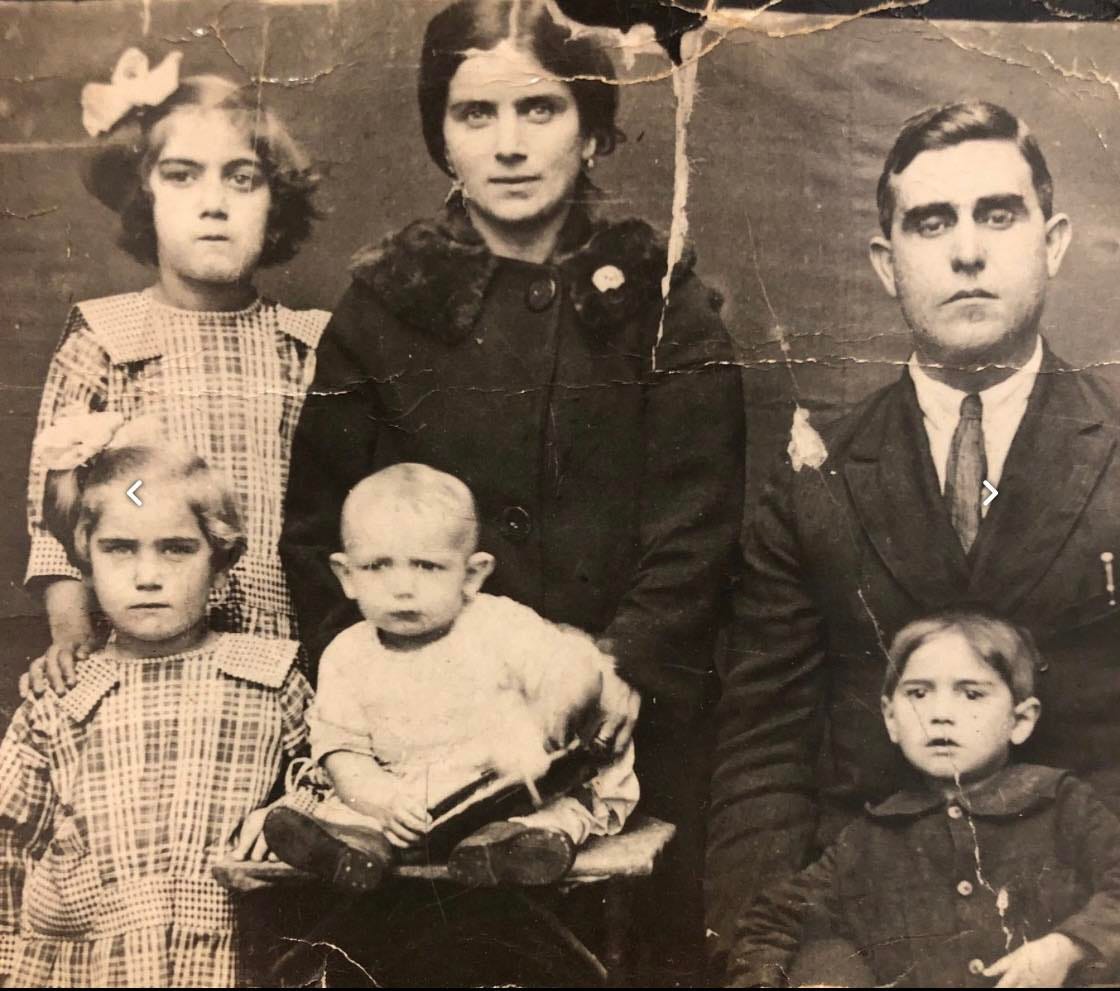
Her great-grandparents, Salvatore Menditto and Giovanna Picarella (pictured at the top), came from southern Italy right around the same time America was deciding just how many Italians it wanted to allow. Salvatore was born north of Naples in 1885; Giovanna was born north of the Amalfi Coast in 1895.
They were married in Italy, then Salvatore crossed the Atlantic with his younger brother Nicola via Ellis Island around 1920, which was just before the 1924 Johnson-Reed Act designed to cut Italian immigration of this exact nature.
So my own children owe their very existence to an “Italian explorer”—a second one, who, like Columbus, also came to America on a voyage across the Atlantic.
Eventually, this Italian Catholic with vision brought over his wife and raised a family with at least nine children in a world that was new to him.
As a poor immigrant peasant, the son of a mule driver, he became a naturalized citizen and renounced his Italian citizenship in 1926, likely for survival—becoming an American citizen was one practical way that Italian immigrants could establish permanence and reduce their vulnerability as “aliens.”
That is as American a story as I can imagine. The good along with the bad.
In 2020, I watched as people who claimed to care about racial justice found statues of men all over the country and vandalized, defaced, and destroyed them.
At first, I thought there might be a case for reconsidering some of the monuments we’ve made of “great men” from our history.
In the very beginning, I thought there might be something to asking people to reconsider who we were celebrating, and why.
Should we have statues of slaveholders or Confederate generals?
That was a good question, I thought.
Very quickly, though, I noticed that nobody was actually suggesting we simply “reconsider” anything. They were demanding, with violence, that we remove all history of these people from our country’s past.
They didn’t bring speeches and arguments, but rather, torches and pitchforks.
They ruined public and private property, ripping down statues of historical figures, including Columbus, and spray-painting priceless works of art.
They killed. They smashed. They destroyed.
And that is what awoke me from my dogmatic slumber.
So when I saw that Columbus Day was on the chopping block, I decided to look into it, and I came to a different conclusion.
My conclusion is that Christopher Columbus was a brave explorer with a complicated past, from which we draw our heritage and history—all of us, as Americans. And that he and the holiday named for him should be celebrated.
As it stands, I celebrate Columbus Day because intelligent people can understand that celebrating a man, or a man’s achievements, does not mean you endorse everything about him. Just like celebrating a country does not mean you endorse everything it does.
I celebrate what Columbus achieved: a monumental discovery for the Old World that was the first step toward the advanced civilization we have today in what was once called the New World.
We should all celebrate that. We can also have a conversation about what his voyage meant at the time, and what it means today, the good and the bad.
But just as I live in a country with a complicated past, with many transgressions, I will never be ashamed of being an American.
I will also not be ashamed of celebrating Columbus Day.
Today, I encourage you to read some Columbus Day proclamations. Here are some excerpts:
Columbus stood in his age as the pioneer of progress and enlightenment. The system of universal education is in our age the most prominent and salutary feature of the spirit of enlightenment, and it is peculiarly appropriate that the schools be made by the people the center of the day’s demonstration. Let the national flag float over every schoolhouse in the country and the exercises be such as shall impress upon our youth the patriotic duties of American citizenship.
Columbus’s vision and daring, and that of the courageous men who followed him, brought European civilization to the New World. His conquest of the Atlantic—the “outer space” of the fifteenth century—is as meaningful to Americans of the space age as it was to our forefathers who pushed across the vast expanses of this continent.
When Columbus and his crew made landfall on the islands of the present-day Bahamas… They unleashed a bold new age of discovery that expanded the horizons of knowledge, carried the splendors of the Western world across an ocean, and set in motion the forces that would culminate in the miracle of July 4, 1776. When they arrived, as a sign of devotion to God and respect to Ferdinand and Isabella of Spain, Columbus raised a mighty cross in the newly discovered land as a sign that “Your Highnesses hold this land for your own, but chiefly as a sign of our Lord Jesus Christ.”
So, Happy Columbus Day to those who celebrate.
I won’t kowtow to the angry mob who can’t understand nuance, who are demanding, once again, that we remove all history of these people from our country’s past.
And for those who don’t (yet) celebrate Columbus Day, do your own research. Come to your own conclusion. Celebrate—or don’t—but at least do so with an educated view.
P.S. For Christians, there’s an especially interesting reason to celebrate Columbus, the man, and his voyage. His bizarre signature (that I mentioned above) is an endless source of fascination not just for myself but for historians as well. Many people have tried to decipher its cryptic meaning and its many variations.
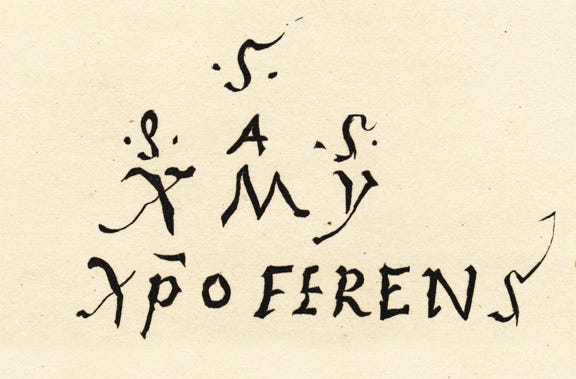
The “X. Ferens” I remember seeing in my childhood is actually “Xpo-Ferens,” which was a Greek-Latin hybrid meaning “Christ-Bearer.” On this Columbus Day, I suggest you take a few minutes to look into it. The story behind it is fascinating.